
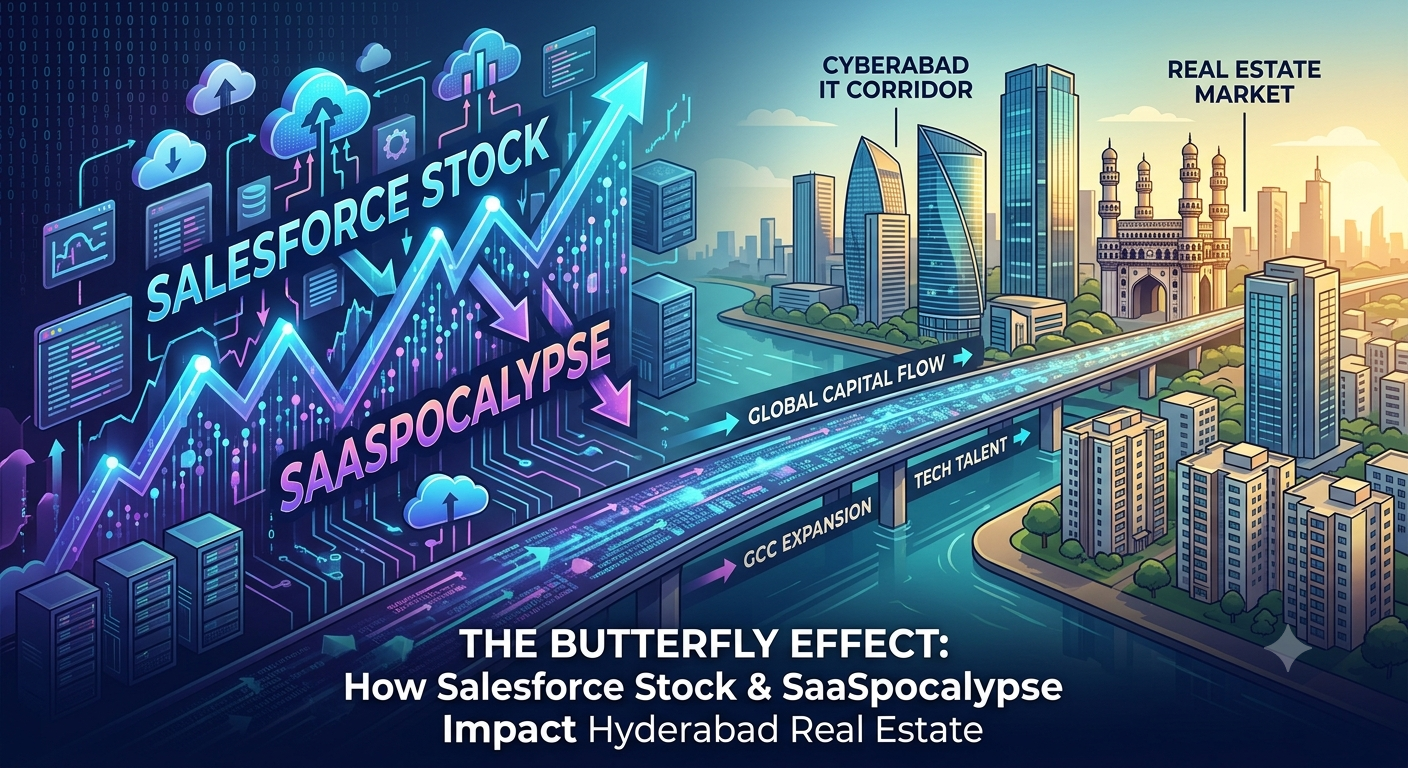
At first glance, the stock price of Salesforce (NYSE: CRM) trading on the New York Stock Exchange and the price per square foot of a luxury high-rise apartment in Kokapet or Financial District might seem entirely unrelated.
One measures global corporate demand for enterprise software; the other tracks brick, mortar, and land in Southern India.
However, in today’s deeply interconnected global economy, an invisible pipeline directly connects Silicon Valley software valuations to Hyderabad’s skyline. This shift, dubbed by tech analysts as the "SaaSpocalypse"—the structural repricing of Software-as-a-Service (SaaS) companies due to generative AI disruption—is reshaping commercial and residential real estate across Hyderabad.
Here is how the dominoes fall from Wall Street to the Cyberabad IT corridor.
1. The Anchor Metric: What Salesforce Stock Represents
Salesforce isn't just another tech stock; it is the bellwether of the global software industry. When enterprise software experiences a valuation correction, Salesforce's stock price acts as the barometer.
R&D and Operational Budgets: When SaaS stocks trade at premium multiples, companies expand headcount, double down on offshore capabilities, and lock in long-term office leases.
The AI Pivot: As software models pivot from traditional subscription seat licenses to AI-agent execution model pricing, Wall Street has fundamentally re-evaluated enterprise SaaS revenues.
Global Capability Centers (GCCs): When software giants face margin pressure or stock pullbacks, their primary strategic move is cost optimization—which often means restructuring global operations.
2. Enter the "SaaSpocalypse": The Tech Shift
The term SaaSpocalypse describes the market reset where hundreds of billions in enterprise software market cap recalibrated practically overnight. The core driver? Generative AI disruption.
When enterprise clients realize AI tools can automate workflows that previously required hundreds of specialized SaaS seats, traditional enterprise software models face structural headwinds.
Pre-SaaSpocalypse EraPost-SaaSpocalypse LandscapeSeat-based Pricing: Revenue grew by adding more headcount.Outcome-based Pricing: Revenue tied to AI agent execution; fewer human seats required.Massive Office Footprints: Expanding offshore capability centers aggressively.Footprint Optimization: Subleasing excess space, prioritizing high-skill AI talent over pure scale.Generous ESOPs: High disposable income for offshore tech leaders.Tempered Compensation: Equity value adjustments leading to cautious personal spending.3. The Transmission Mechanism: How It Hits Hyderabad
Hyderabad has grown into one of India’s premier destinations for technology investment, housing massive Global Capability Centers (GCCs) and engineering operations for companies like Salesforce, Microsoft, Amazon, and Google.
When tech multiples compress in California, the ripple effect reaches Telangana through three primary channels:
A. The ESOP & High-Earner Wealth Effect
A significant portion of purchasing power in Hyderabad’s premium housing markets (such as Gachibowli, HITEC City, Kokapet, and Tellapur) comes from senior tech executives whose compensation packages are heavily tied to US stock equity (RSUs and ESOPs).
When SaaS stock prices soar, tech leaders leverage their stock payouts as down payments for luxury villas and 4BHK apartments.
When stock valuations normalize or experience volatility, high-ticket residential buyers become far more cautious, lengthening purchase decision cycles.
B. Commercial Real Estate Absorption
Hyderabad's commercial office space absorption historically depended heavily on the IT-BPM sector.
Shift to GCCs: While traditional third-party IT services experienced moderation during the software repricing, GCC expansion surged to absorb available grade-A office space.
Efficiency over Footprint: Software firms experiencing margin pressures rethink large physical footprint expansions. Rather than leasing 500,000 sq. ft. in one go, tech tenants are shifting toward consolidated, high-efficiency footprints.
C. Developer Strategy and Supply Re-calibration
Following years of rapid launch activity, Hyderabad developers have adjusted to market conditions.
Developers are becoming increasingly selective with new project launches, adjusting launch supply while focusing on completing existing projects.
Residential pricing has shown resilience, but growth patterns have shifted from rapid speculative price jumps to end-user-driven, steady appreciation.
The Big Picture for Hyderabad Investors
The relationship between Salesforce stock, the SaaSpocalypse, and Hyderabad real estate highlights a key lesson: Hyderabad's property market is globally integrated.
The market is no longer driven purely by local economic factors. The real estate market in Cyberabad operates as an downstream consumer of global tech capital flows. While the initial shockwaves of global software recalibration caused market moderation, Hyderabad’s strategic shift toward becoming a preferred hub for global AI research and GCC operations continues to provide a strong structural foundation.
For real estate buyers and investors on Hyderabadnow.in, watching Wall Street tech earnings and enterprise software trends isn't just financial trivia—it’s an early indicator for where local property prices, office vacancy rates, and rental yields are heading next.