
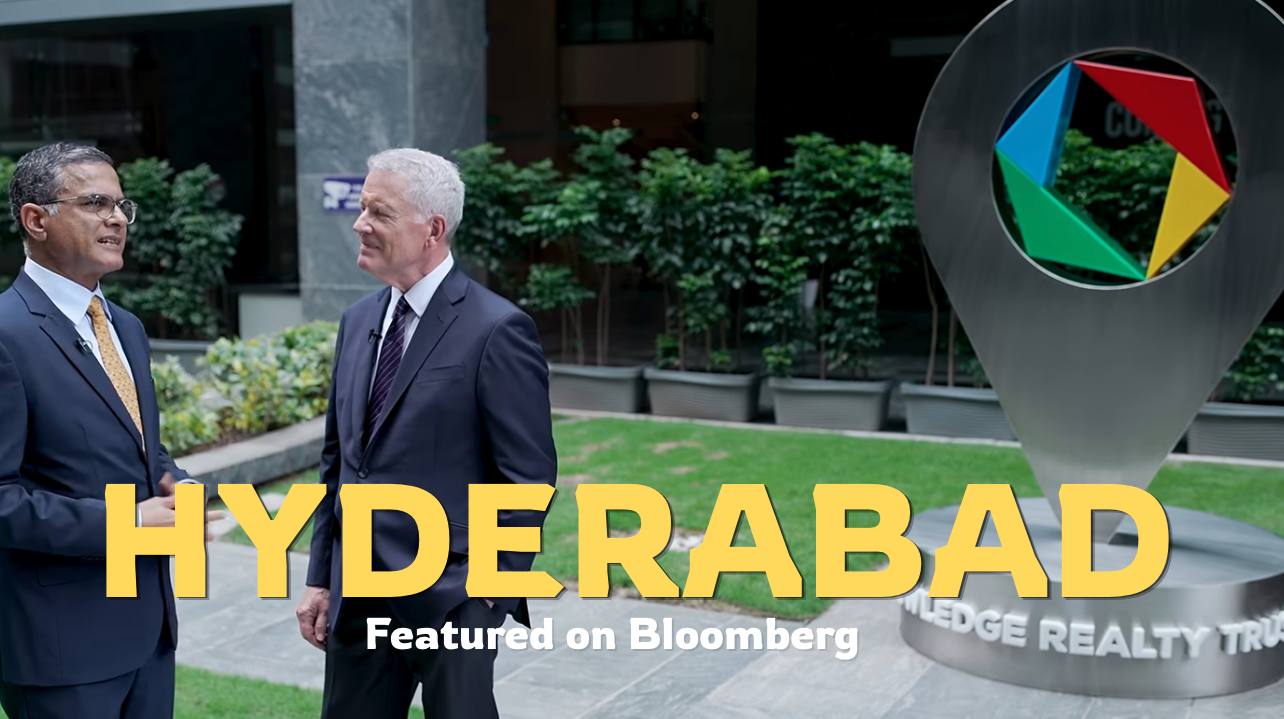
Hyderabad is rapidly accelerating its transformation into India’s premier technology and commercial real estate hub. Highlighted in a recent Bloomberg Television feature exploring why big tech and international institutional investors are heavily betting on the city, Hyderabad's real estate trajectory reveals a shift driven by long-term planning, institutional capital, and resilient office demand.
For property investors, corporate tenants, and market observers tracking Hyderabad’s commercial and residential growth, here are the key takeaways from how global institutional players view the city’s evolving landscape.
1. Institutional Backing: Sattva Knowledge City and the Rise of REITs
A core driver behind Hyderabad’s commercial real estate standard is institutional investment. Modern developments have shifted away from low-cost construction toward campus-style environments with integrated retail, green spaces, and worker-centric infrastructure.
Sattva Knowledge City: Spanning a massive footprint with ~75,000 workers on-site, this park is considered a flagship asset within the Knowledge Realty Trust portfolio (backed by Blackstone). It hosts global tech and finance powerhouses including Apple, Microsoft, Amazon, Meta, and JP Morgan.
The Scale Advantage: While Bengaluru remains India's largest office market (~300 million sq. ft.), Hyderabad’s grade-A office stock has expanded dramatically to around 160 million sq. ft., up from a fraction of that size a decade ago.
REIT Legislation: Institutional investors like Blackstone worked with Indian policymakers to establish Real Estate Investment Trusts (REITs). This legislative shift enabled institutional owners to access public markets, driving down capital costs and accelerating development across key micro-markets.
2. Global Capability Centers (GCCs): The New Anchor Tenants
The nature of commercial office space in Hyderabad has matured beyond traditional back-office operations.
Traditional Call Center ---> Back Office ---> Mid Office ---> Front Office / GCCHigh-Value Support: Global Capability Centers (GCCs) now dominate leases across HITEC City and Knowledge City. These units drive core technological support and global product operations for MNCs.
Evolution of Work: Rather than shrinking under the threat of automation, global tech requirements have increased GCC demand, cementing Hyderabad’s role as a core innovation hub rather than just a cost-saving destination.
3. Deliberate Urban Planning & Academic Clusters
Unlike growth patterns driven purely by spontaneous market absorption, Hyderabad’s tech corridor was built through intentional policy decisions and institutional clustering.
Talent Infrastructure: The intentional placement of premier institutes—such as the Indian School of Business (ISB) and IIIT Hyderabad—alongside major commercial nodes created an immediate, renewable supply of engineering and managerial talent.
Learning from Competitors: Urban growth in Hyderabad benefited from analyzing early tech hubs like Bengaluru, prioritizing infrastructure readiness, human capital development, and lower barriers to entry for global firms.
4. Multi-Sector Resilience: Genome Valley & Tech Convergence
Hyderabad’s real estate ecosystem does not rely solely on IT/ITeS. The city’s economic foundation is further strengthened by a thriving life sciences and biopharma sector.
Genome Valley: Anchored by leaders like Bharat Biotech, Genome Valley stands as India's largest biotechnology cluster.
Diversified Demand: The combination of life sciences in the city's periphery and high-density tech/GCC developments in the western corridor creates a balanced real estate environment that shields the overall commercial market from sector-specific slowdowns.
5. Navigating the AI Shift in Commercial Real Estate
With news around AI automation impacting IT service staffing (such as headcount recalibrations at major tech services firms), concerns regarding future office space absorption naturally arise. However, market fundamentals remain solid:
GCC Expansion: As global firms accelerate AI adoption, their internal GCC footprints require more advanced infrastructure, maintaining strong leasing activity.
Reskilling & Enterprise AI Deployment: Enterprise adaptation to AI creates fresh demand for talent, consulting, and technological deployment, ensuring that overall commercial space requirements remain robust for the foreseeable future.
What This Means for Real Estate Buyers & Investors
Commercial Yields: Grade-A office parks backed by REITs continue to show high occupancy rates and reliable rental yields.
Residential & Retail Spin-offs: The continuous influx of high-earning tech and management professionals into corridors like Knowledge City, Raidurg, and Gachibowli continues to drive premium residential demand and mixed-use retail developments in West Hyderabad.
Stay tuned to hyderabadnow.in for local market breakdowns, project walkthroughs, and real estate insights across Hyderabad.